Why AI is levelling out large and small companies

Digital moat, lost

Thought:

Why AI is levelling the playing field between larger and smaller companies.

Written by Michael Faursby-Ahlers, CTO & Co-owner, Stretch Qonnect.

Looking at the competitive landscape of organizations in the business to consumer (B2C) and the business to business (B2B) space, I see indicators showing that established organizations’ digital advantage is being eroded to a point where its effectiveness as a moat is mostly non-existent.

This is most relevant for commodity service providers, where their selling points are the customer experience, price and related services. Like electricity, shipping, internet providers, online shopping.

Traditionally large and established organizations had a digital moat in the form of their abilities to service customers through digital services. Services that traditionally are costly to buy, develop and maintain.

Anyone considering entering a market has two paths.

  • One, supply services on the same level and have a competitive price.
  • Or two, compensate for the lesser customer experience with a substantially lower price. Hence lower profits. That is changing.

What that tells us:

The reality today is that,

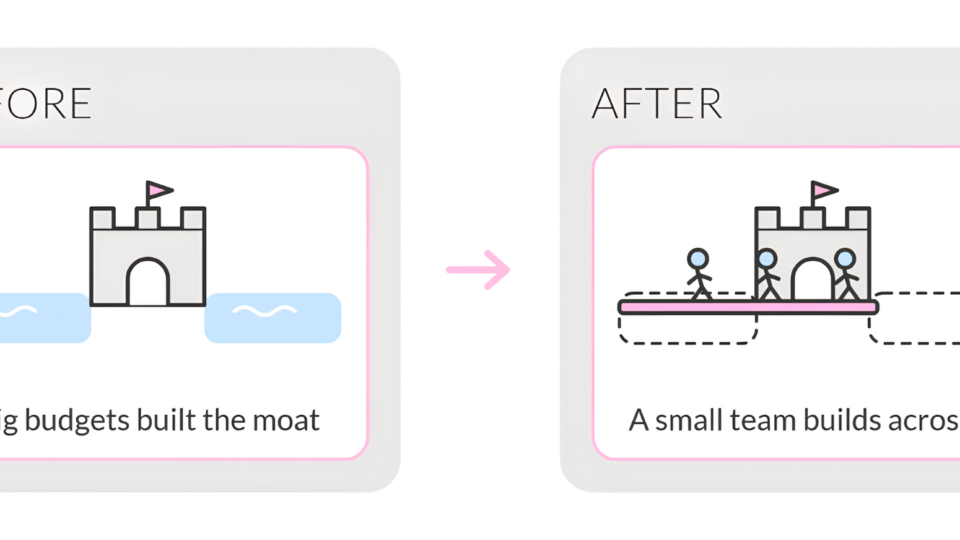
with a fairly small and competent team, let’s say two to four persons, is capable of building and fielding an end-to-end competitive digital customer experience well within half a year.

This includes website, applications for multiple smartphone platforms, an AI driven customer experience, and an operational customer handling system. This would have been near impossible a few years ago.

This situation effectively removes the digital moat that the larger and established organizations have had traditionally.

A common sentiment I am often met with in large organizations is along the lines of:

We can afford to throw AI at everything and “out-spend” smaller companies to deliver a better customer experience and justify the higher price. This seems like a simple solution. But if the additional profit is being consumed by the higher technology spending, from a total economic perspective, that strategy will arguably be less attractive.


The digital moat is lost

Diving into the details:

What insights are required to drive the decisions?

It depends on customer base size in relation to the organization’s size.

Low customer to organization ratio

For an organization with a low ratio the key is to have a holistic customer perspective. Where an organization with higher ratio looks at the overall customer-base, the organization with a low ratio can afford to look at the individual customers.

  • Closer interaction with customers,
    • A holistic customer picture is paramount
  • Knowledge sharing
    • Quickly follow up on customer related events to minimize churn
  • Each customer is more important to the organization’s performance
    • Being proactive on a customer level driving larger customer engagement
  • Large potential to expand the customer base
    • Being selective in targeting customers with higher expected profitability

High customer to organization ratio

For an organization with a higher ratio, a key capability to have is a holistic customer-base perspective. Where an organization with a lower ratio is focused on the individual, an organization with a higher ratio is focused on the interaction of the entire customer base.

  • Large customer base and more potential for collecting information,
    • Should be used for improving the products and user experience.
  • Have the ability and capacity to push the digital services to new and better levels
    • Delivering new services and products
  • Large range of products
    • Can deliver an integration between products and services that improves the customer experience and supports new products and services.

As seen from the above, that a holistic view of customer and/or customer base is essential for positioning an organization. From this flows a series of requirements for data governance, a common way of looking at process, service and products.

Questions about what this means for your organization? Get in touch.

– Michael Faursby-Ahlers, CTO, Stretch Qonnect | Qloud Cover

Contact Form

Want to (data) drive decisions today? Reach out.

    Planlæg online